
Slate roofs have always been the hardest surface to mount solar on. Every existing solution either risks cracking the slate, invites water ingress, or takes three times as long as it should. Safe Slate fixes all three — here's how.
Why slate has always been a problem
Since the beginning of solar installation, slate roofs have been a genuine headache. The traditional method was straightforward enough in theory — drill through the slate, fix an anchor bolt straight into the rafter. The anchor bolt itself is an excellent structural fixing. That part was never the issue.
The issue was what happened between the bolt and the slate.
Slate is brittle. Any contact — even minor movement from wind loading or thermal expansion — risks cracking it. Traditional installations drilled a hole barely larger than the bolt, leaving almost no clearance. If the bolt shifted even slightly, it was touching slate. And cracked slate means water ingress. And water ingress on a roof means a very unhappy customer and a very expensive callback.
What everyone else does instead — and why it doesn't work
The industry responded to the cracking problem with two alternative approaches. Both have serious flaws.
The first is the angle grinder cut-out. Instead of drilling a round hole, you cut a square hole through the slate with an angle grinder. This is slow, dirty, dangerous work on a rooftop. And a square cut removes far more material than a round hole — it significantly weakens the structural integrity of the slate. You've traded one risk for a worse one.
The second approach is the over-slate plate — a bracket that sits on top of the existing slate and loads the panel weight down onto it. Think about that for a moment. You wouldn't pack your weekly shopping with the heavy tins on top of the fragile items — it's the same logic. Slate is not designed to take point loading from above. This approach is asking for cracked slates and leaks. It's only a matter of time.
How Safe Slate solves it
We went back to first principles. The anchor bolt is a great fixing — we kept it. The problem was bolt-to-slate contact — we eliminated it entirely.
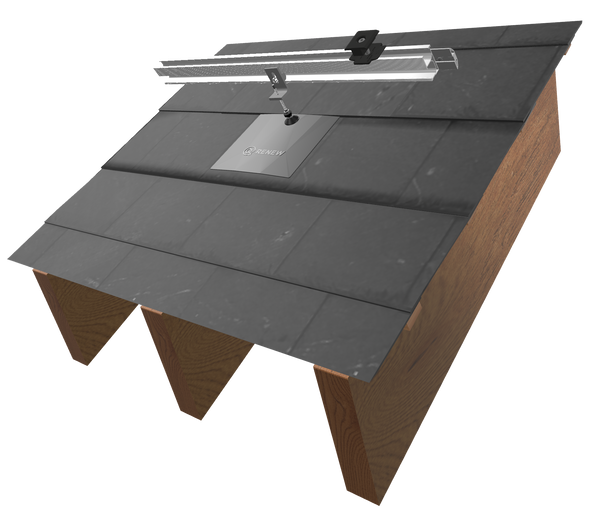
Safe Slate drills a 25mm hole through the slate into the rafter. The bolt itself is only 10mm. That's 15mm of clearance on every side. The bolt cannot touch the slate. Not during installation, not in high winds, not ever.
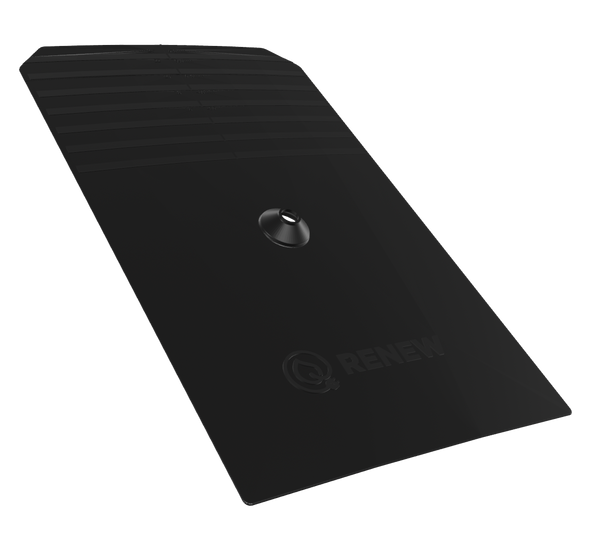
The hole is then sealed with a flexible plastic flashing that matches the exact size and overlap of a standard slate tile. It slides under the slate naturally, fixes only to the bolt — not to the slate — and creates a completely weatherproof seal. No mechanical fixing to the slate. No stress on the slate. No possibility of water ingress.
And if the installer drills in slightly the wrong place — which happens, on every roof, to every installer at some point — the flashing covers it completely. There is no scenario in which a misdrilled hole causes a leak.
How it compares
5 reasons installers choose Safe Slate
Ready to take slate roof installs off the problem list?
See the full Safe Slate spec and order direct from the Renew store.
25mm hole · 10mm bolt · Full flashing included · No slate contact